


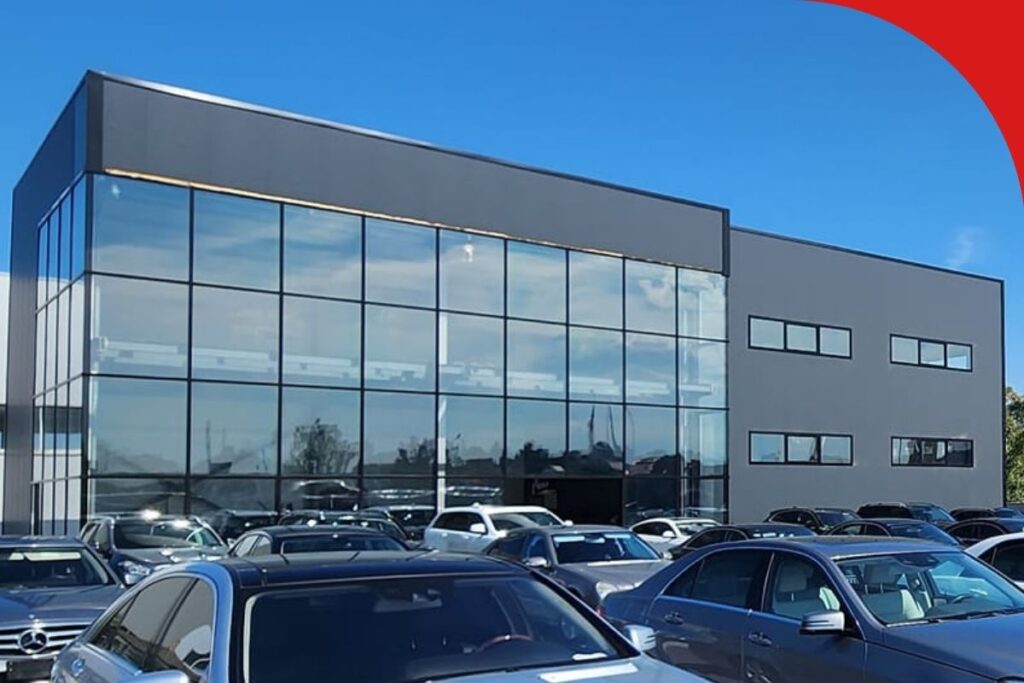
In modern industrial, logistics, and commercial buildings, sandwich panels never work in isolation. They interact with hybrid roofing systems, curtain walls, photovoltaic installations, advanced glazing systems, and waterproofing membranes.
Ensuring seamless integration between these components means achieving:
- high thermal and structural performance;
- aesthetic and functional continuity;
- simplified, trouble-free installation;
- enhanced durability of the entire building envelope.
Only a comprehensive approach to the building envelope allows sandwich panels to deliver their full potential within increasingly integrated roofing and facade systems.
Compatibility Between Sandwich Panels and Curtain Walls
Glass and aluminum curtain walls require tight tolerances and precise interfaces with sandwich panels. To ensure perfect compatibility, it is essential to verify:
- Air and Water Tightness
- Use of suitable compressible tapes and sealants.
- Fasteners correctly sized according to actual wind loads.
- Proper joint alignment to prevent thermal bridges and water infiltration.
- Alignment of Levels and Dimensions
- Actual panel thickness
- Roof slopes
- Geometry of secondary support structures
Compatibility with Windows, Doors, and Closure Systems
The interface between sandwich panels and closure systems, including windows, doors, and smoke vents, is often a critical aspect of the project.
To ensure proper installation:
- openings must be accurately cut and properly protected;
- compatible frames and accessories should be used, preferably supplied by the same manufacturer;
- joints must be correctly sealed to prevent water infiltration.
These aspects are among the most common installation issues highlighted in technical documentation.
For this reason, our production facility includes a department dedicated exclusively to accessories, from standard flashings to custom-designed solutions tailored to specific projects. This ensures maximum compatibility between our sandwich panels and project-specific accessories.
Integration of Sandwich Panels with Photovoltaic Systems
Photovoltaic systems are among the technologies most frequently integrated with metal roofing solutions. ItalPannelli panels are compatible with PV systems through certified fixing systems as well as our own photovoltaic module, manufactured directly by ItalPannelli.
Key Aspects to Verify:
- Fixing system type: it must match the panel geometry and rib profile.
- Avoidance of improper perforations: preserving roof integrity, warranties, and weather tightness.
- Additional loads: photovoltaic systems affect permanent, concentrated, and wind loads, making structural verification during the design stage essential.
The most common specification errors often involve roof slopes, fixing methods, and support spans.
Roof-to-Wall Junction: A Critical Interface
The connection between roof and wall is one of the most sensitive areas of the building envelope. Standard technical details typically include:
- ground connection details;
- roof-to-wall junctions;
- panel joints;
- interfaces with skylights.
Proper design ensures:
- thermal continuity;
- effective rainwater management;
- improved durability of sealing systems;
- greater resistance to wind and water infiltration.
Sandwich Panels and Waterproofing Membranes
In single-skin roof panel systems, the application of bituminous or synthetic waterproofing membranes is common practice.
For optimal compatibility:
- the panel must provide a suitable substrate, such as mineralized felt or synthetic membrane support;
- connections between waterproof membranes and flashings must be executed according to technical guidelines.
Why Integrated Design Is Essential
Compatibility is not an optional feature but a fundamental design process.
For optimal project development, involving the ItalPannelli Technical Department from the earliest design stages is highly recommended in order to:
- verify roof slopes and load requirements;
- select the most suitable panel solution;
- avoid improper applications;
- define original accessories and construction details.
Summary
Ensuring compatibility between sandwich panels and other building systems provides:
- superior thermal and structural performance;
- greater durability;
- fewer installation errors on site;
- a harmonious, high-performance building envelope over time.
Only through the proper design of joints and interfaces can sandwich panels fully express their performance within an integrated construction system.
👉 Planning a roofing or facade project using sandwich panels?
Early-stage technical consultation helps prevent design errors, optimize performance, and ensure full compatibility between sandwich panels and integrated building systems.
Discover how ItalPannelli can support your project from the design phase onward.